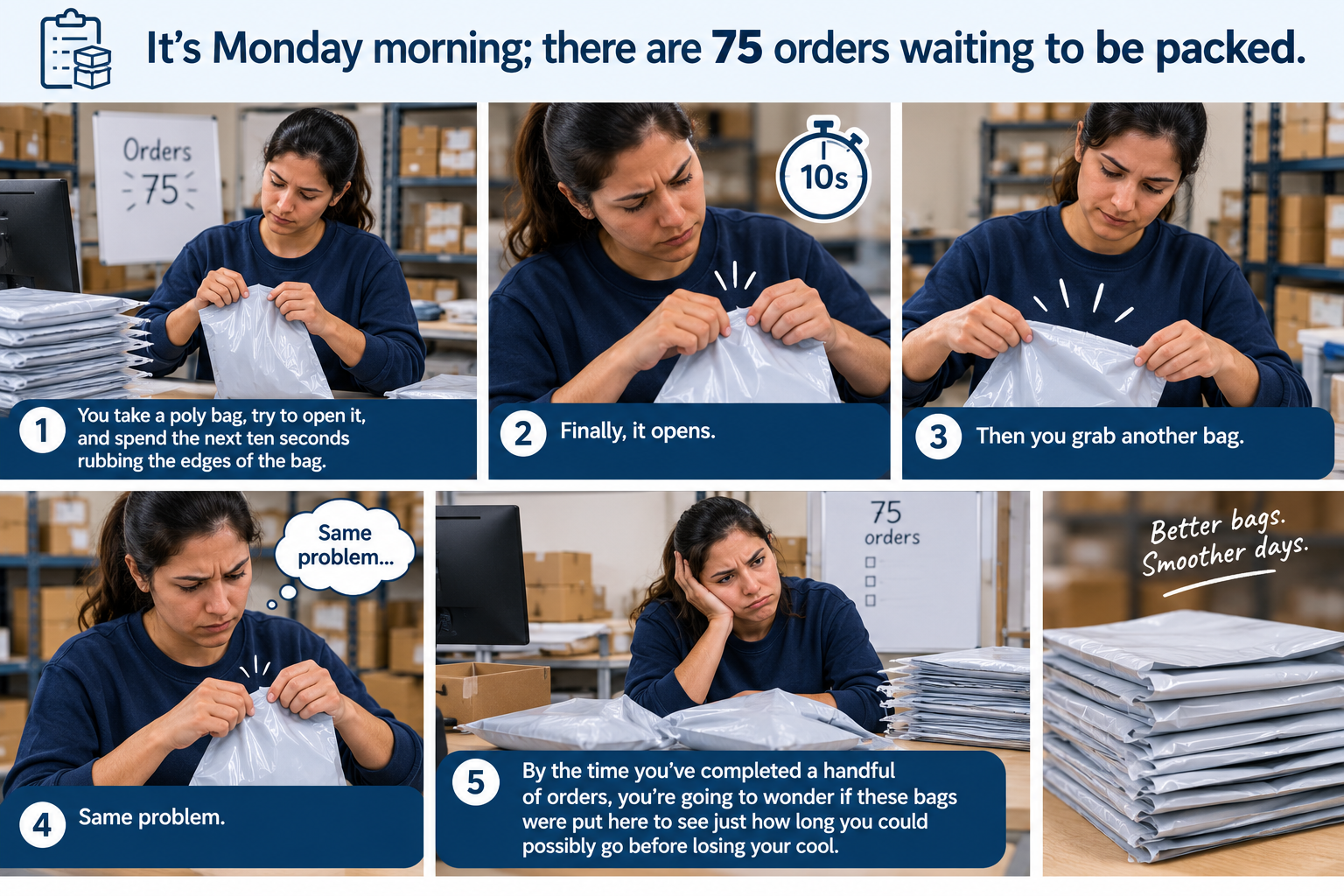
It’s Monday morning; there are 75 orders waiting to be packed.
You take a poly bag, try to open it, and spend the next ten seconds rubbing the edges of the bag.
Finally, it opens.
Then you grab another bag.
Same problem.
By the time you’ve completed a handful of orders, you’re going to wonder if these bags were put here to see just how long you could possibly go before losing your cool.
To organizations that constantly package and ship their products every day, small issues such as these can cost an unbelievable amount of time.
This is precisely why selecting the correct poly bags is so important.
Poly bags are very versatile; they can be used to package anything from clothing to small parts to printed materials, etc. They help maintain packaging integrity (keep the product contained) and protect against dust, dirt, and light moisture damage.
Not all poly bags are suitable for every project.
one of the first considerations when purchasing a poly bag is its size. For instance, if you sell t-shirts, you’ll want a poly bag that will hold a folded t-shirt with minimal excess plastic.
A bag that is too small makes filling the item difficult while a bag that is too large results in wasted plastic and looks sloppy once packaged.
Another consideration is the thickness. The thickness of a poly bag is typically measured by “mils” which can range anywhere from 0.5 mil to 20 mil. In general, the lower the number (i.e. 1 mil), the thinner the poly bag. Thicker poly bags provide additional protection (to prevent tears or punctures). Therefore, depending upon whether you are shipping lighter weight merchandise or heavy weight merchandise or merchandise that has sharp edges/points, a thinner or thicker poly bag would be a better option.
In addition to selecting the proper size and thickness of poly bags, one must also give some thought to how you plan to seal the bag. There are several options available. Some poly bags contain adhesive strips pre-attached to the top flap. Other poly bags require either tape, twist ties, or heat sealing equipment to seal the top flaps. Which type of closure method is best for your particular application will depend primarily on the types of merchandise being shipped and the speed at which you need to complete the packaging task.
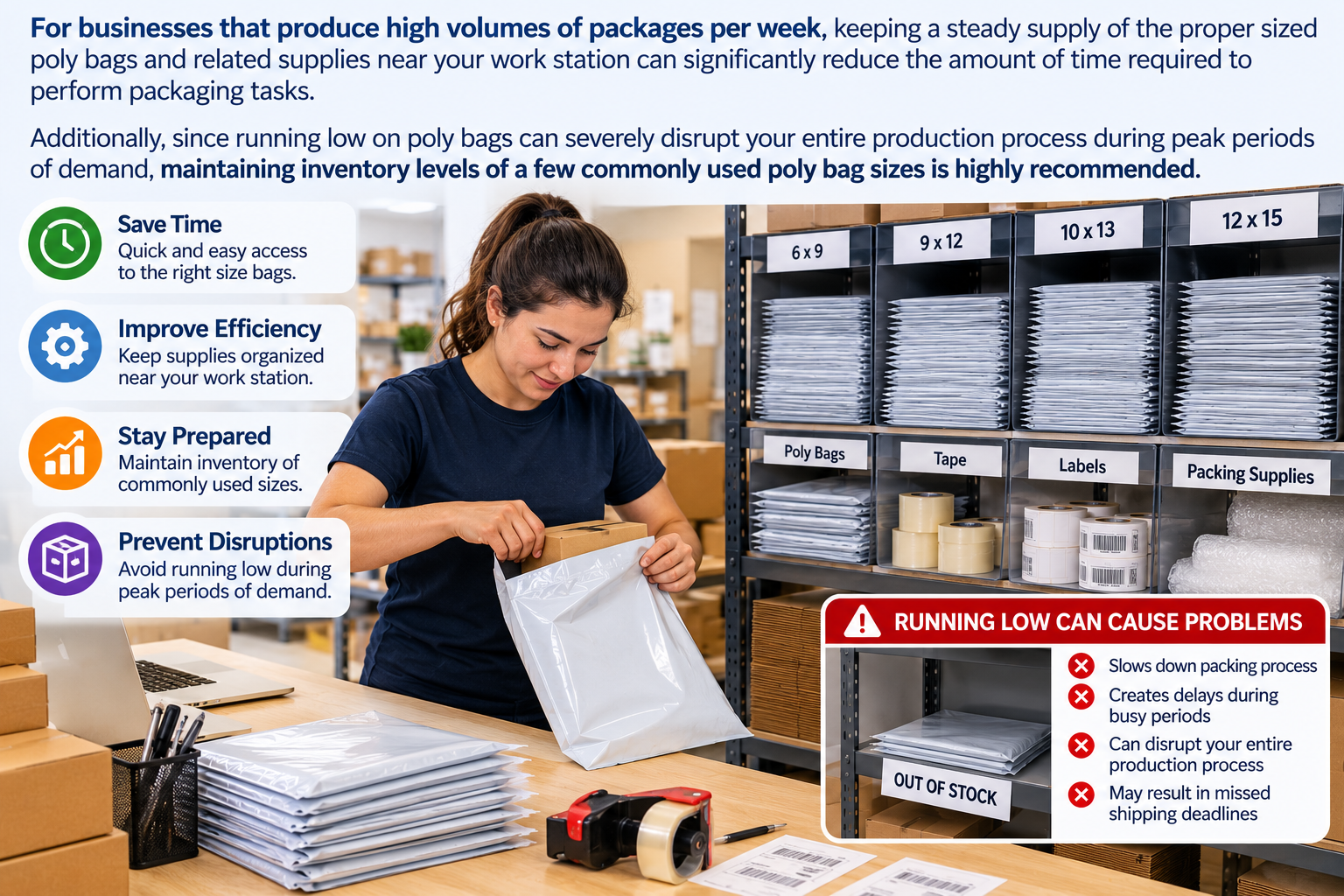
For businesses that produce high volumes of packages per week, keeping a steady supply of the proper sized poly bags and related supplies near your work station can significantly reduce the amount of time required to perform packaging tasks. Additionally, since running low on poly bags can severely disrupt your entire production process during peak periods of demand, maintaining inventory levels of a few commonly used poly bag sizes is highly recommended.
Packaging supplies provides a wide variety of poly bags in various sizes and gauges for numerous applications including storing merchandise, organizing small parts and preparing merchandise for shipment. Whether you use poly bags for storing clothing, separating small parts or preparing merchandise for shipping, we believe that using the correct size and gauge poly bag can greatly enhance efficiency and minimize unnecessary material waste.